Screen-Accurate or Inspired? A Better Way to Read Prop Listings
“Screen-accurate,” “inspired,” “replica,” and “licensed” often appear near each other in cosplay shopping. They answer different questions. Some describe an appearance goal, while another concerns an official commercial relationship. Treating them as interchangeable can lead you to expect details a listing never actually establishes.
The most useful first step is to define what you want the object to resemble. A character can have several costumes and prop versions across films, games, promotional images, and fan interpretations.
Choose the reference before judging accuracy
Pick a particular version and identify the visual details that matter to you. Those might be the outline, the position of a colored panel, the shape of a light pattern, or the relationship between the prop and the sleeve.
Use more than one view when available. A single image can hide depth, scale, or the underside. Lighting and camera angle can also change how a color or surface appears. Keep your reference notes specific enough that you can compare them with an actual listing.
Read “inspired” as a creative relationship
An inspired piece may borrow a recognizable idea while changing proportions, details, materials, or mounting. That can suit a personal interpretation or a comfortable costume. It does not necessarily promise a one-to-one match with a particular frame.
If a seller uses this term, ask which version or design cues the item follows. Decide whether those cues match your own priorities instead of assuming every familiar name refers to the same object.

Ask what “screen-accurate” means in the listing
The phrase expresses a claim about resemblance, but you still need evidence of the details you care about. Look for consistent photographs, dimensions, multiple angles, and an identified reference version. A confident adjective is not a substitute for a clear view of the item.
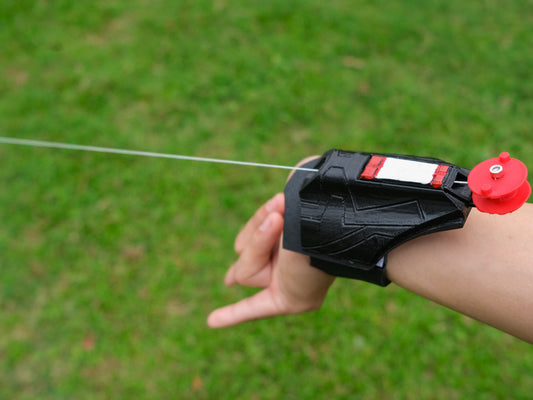
Separate appearance from function. A prop may resemble a fictional device without reproducing its fictional abilities. A wearable web shooter is not climbing equipment, and a glowing arc reactor is not a power source for a suit.
Keep “licensed” in its own category
A familiar character name, a close visual resemblance, or the word “replica” does not itself establish an official license or endorsement. If official licensing is important to your purchase, look for explicit information that can be checked rather than inferring it from the styling.
This is a way to read product descriptions, not a judgment about the legal status of a particular item. When a listing does not provide the evidence you need, ask the seller directly instead of filling the gap with an assumption.
Use a personal accuracy scorecard
| Detail | Your priority | Evidence to seek |
|---|---|---|
| Silhouette | Essential or flexible | Front and side views |
| Color placement | Essential or flexible | Clear ordinary-light photos |
| Scale on the body | Essential or flexible | Dimensions and a fitted view |
| Small decoration | Essential or flexible | Close-up detail |
| Wearability | Required for your event | Fit information and your rehearsal |
You may find that two details matter much more than the rest. That clarity can help you choose a piece that serves your costume without chasing a vague promise of perfection.
Name your own interpretation honestly
When you share a finished costume, describe it in the same precise way: “inspired by this version,” “my original interpretation,” or “focused on the silhouette.” That gives viewers useful context and makes your creative choices easier to appreciate.
Compare the five web shooter styles by visible design, then check the exact product listing for current details. For a record of all sides, use the 360-degree video guide.